2025 Key insights
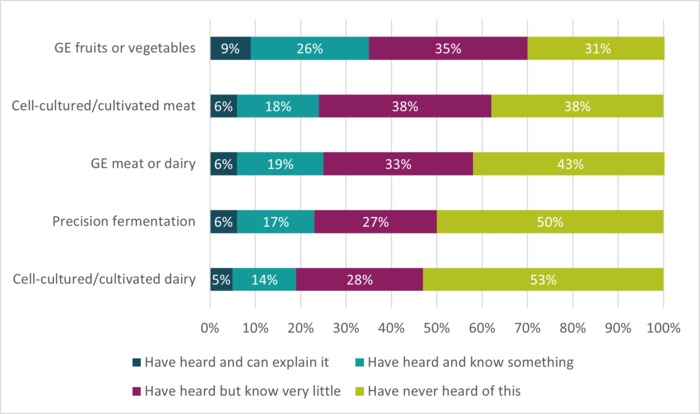
- Most people are unfamiliar with new food technologies. The proportion of respondents who have never heard of cell cultured/cultivated dairy (52.5%) or precision fermentation (50.1%) has remained steady since 2023/24, though there has been a small increase in awareness of gene edited fruit and vegetables, with 30.7% having never heard of these in 2025 compared to 32.3% in 2023.
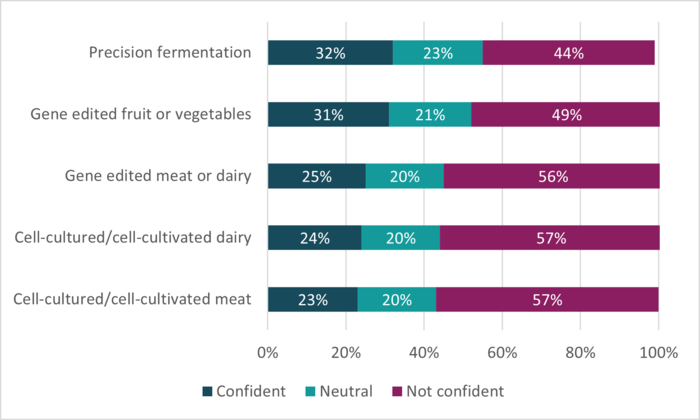
- Confidence in new or emerging foods and technologies remains low overall (44 – 56% not confident, depending on food/technology) though average confidence has risen since 2023. Consumers are most confident about precision fermentation (32.3%) and gene edited fruit and vegetables (30.6%).
-
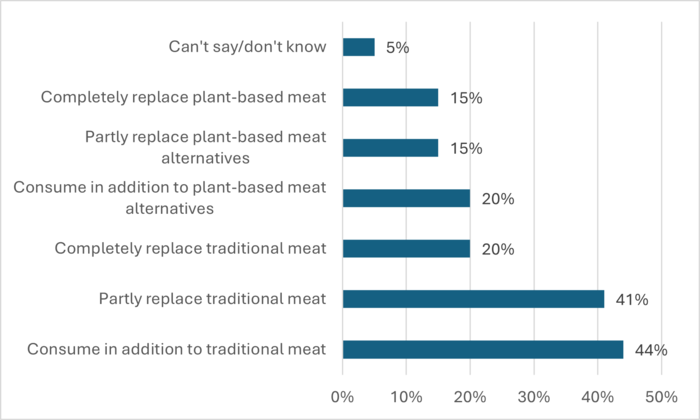
Cell cultured/cultivated meat is seen as a complement to, rather than a replacement for, traditional meat. Among the quarter of respondents who said they would eat it, most expect to consume it alongside traditional meat (43 – 44%) or as a partial substitute (41%).
Download the:
- Sample, methods and survey instrument (PDF 1.2MB).
- New and emerging foods and food technologies module (PDF 351KB).
Awareness of new or emerging and/or food technology
Respondents had limited awareness of new foods and technologies, with the proportion of respondents who had never heard of each food/technology assessed ranging from 31 - 53%. Gene-edited fruit or vegetables had the highest rate of awareness, with 8.9% of respondents feeling confident enough to explain them to others, followed by cell-cultured/cell-cultivated meat (6.1%).
Confidence in the safety of new or emerging food and/or technology
Confidence in new foods and technologies was low overall, with 44 – 56% of respondents selecting confidence ratings below the midpoint of 4 on a 7-point scale for each of the new foods and/or technologies assessed. Consumers were most confident in precision fermentation (32.3% confident) and gene-edited fruit or vegetables (30.6%), and least confident in cell-cultured/cultivated meat (23.1%) and cell-cultured/cultivated dairy (23.7%).
Consumption intentions for cell-cultured/cultivated meat
Just over a quarter (25.9%) of respondents said they intended to include cell-cultured/cultivated meat in their diet, 27.7% said that they were unsure, and 46.3% said that they would not.
|
|
n (%) |
|---|---|
|
Yes |
579 (25.9) |
|
No |
1,034 (46.3) |
|
Can’t say/don’t know |
619 (27.7) |
Among those willing to include it (n = 579) the most common intentions were to consume it in addition to traditional meat (43.5%) or as a partial replacement for traditional meat (40.8%). Fewer respondents intended to consume cell-cultured meat as a complete replacement for traditional meat (20%) or plant-based meat (14.5%).