
2025 Key insights
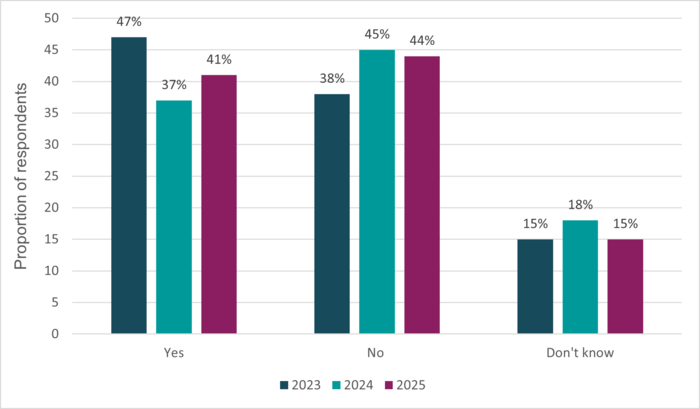
- Forty-one percent of respondents remembered a food recall happening over the last 12 months. This was significantly higher than 37.3% recorded in 2024 but lower than the 46.6% reported in 2023.
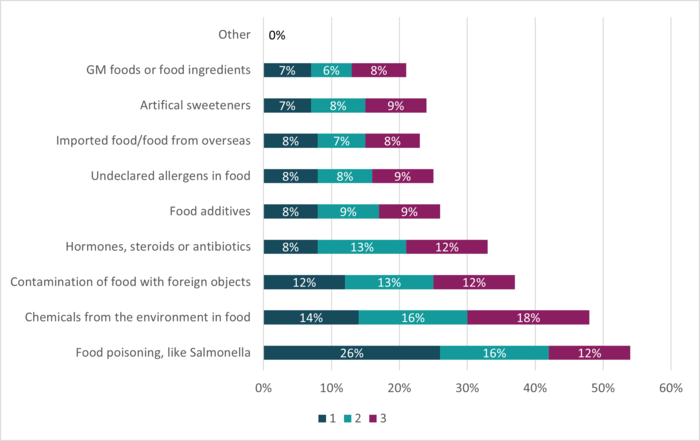
- Food poisoning (such as from Salmonella) was most frequently ranked as the most important food safety issue, cited by 25.9% of respondents, followed by chemicals from the environment in food (13.5%).
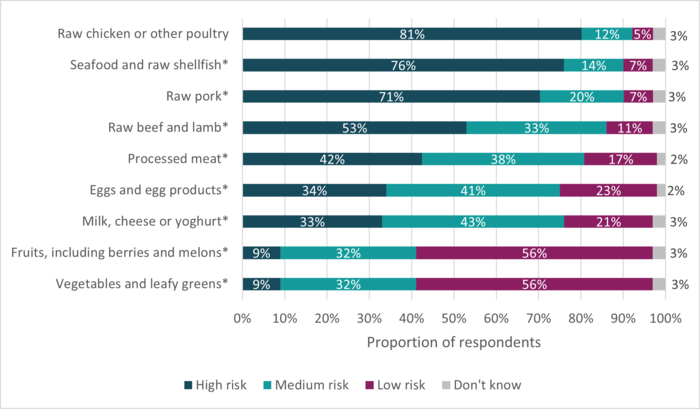
- Raw chicken or other poultry (81.0%) and raw seafood and shellfish (76.3%) were the foods most commonly perceived as high risk if not stored, prepared, and/or cooked correctly at home.
- Most respondents reported consistently practicing key food safety behaviours related to preparing raw meat, with around 6 in 10 always washing hands and cleaning preparation surfaces after handling raw meat. In contrast, using a food thermometer to check chicken is cooked was uncommon: only 8% reported always doing this, while 43.8% reported never doing so.
Download the:
Food recall knowledge
Forty-one percent of respondents remembered a food recall happening over the last 12 months. This was significantly higher than the 37.3% of respondents who remembered a recall in 2024 but lower than the 46.6% in 2023.
Food safety concerns
Respondents rated ‘food poisoning, like Salmonella’ and ‘chemicals from the environment in food’ as the most important food safety issues. Food poisoning was ranked as the number one issue by 25.9% of respondents, with 16.3% and 11.7% respondents ranking it second and third respectively. Chemicals from the environment was ranked as the most important food safety issue by 13.5% of respondents, with 16.1% ranking it second and 17.7% third. Genetically modified (GM) foods or food ingredients and artificial sweeteners were considered the least important issue, ranked first by 7.4% and 6.5% of respondents respectively.
Food risk perceptions
Raw chicken or poultry and raw seafood/shellfish were perceived as the riskiest foods to eat if not stored, prepared, and/or cooked correctly at home. Around 81.0% of respondents rated raw chicken or poultry as high risk (11.9% medium, 4.8% low), compared to 76.3% for raw seafood or shellfish (14.2 medium, 6.9% low). Vegetables and leafy greens (9.0% of respondents rated these as high risk) and fruits including berries and melons (9.2%) were perceived as the least risky foods.
Food safety behaviours
Respondents who indicated that they had some level of involvement in meal preparation at home (n = 2,037) were asked how often they practised food safety behaviours when preparing food at home. Approximately a third of respondents reported always avoiding providing higher risk foods to vulnerable persons (33.2%), refrigerating or freezing leftovers within 2 hours of cooking (35.3%) and consuming fridge leftovers within 2 to 3 days (34.2%). Only a small proportion of respondents reported never engaging in these behaviours (2-9%, depending on the behaviour).
|
1 - never n (%) |
2 - n (%) |
3 - n (%) |
4 - more than half the time n (%) |
5 - n (%) |
6 - n (%) |
7 - always n (%) |
|
|---|---|---|---|---|---|---|---|
| Avoid providing higher risk foods to vulnerable persons* |
187 (9.2) |
72 (3.5) |
85 (4.2) |
212 (10.4) |
283 (13.9) |
347 (17.0) |
676 (33.2) |
| Refrigerate/freeze leftovers within 2 hours of cooking |
86 (4.2) |
78 (3.8) |
103 (5.1) |
315 (15.5) |
344 (16.9) |
391 (19.2) |
720 (35.3) |
| Eat fridge leftovers within 2 to 3 days |
41 (2.0) |
58 (2.8) |
87 (4.3) |
324 (15.9) |
372 (18.3) |
458 (22.5) |
697 (34.2) |
For food safety behaviours related to the preparation of raw meat, more than half of respondents (53 – 59%) reported always practicing 4 of the 5 behaviours assessed. However, only 8.0% of participants reported always using a thermometer to check if chicken is cooked, while 43.8% reported never doing so.
|
1 - never n (%) |
2 – n (%) |
3 - n (%) |
4 – more than half the time n (%) |
5 - n (%) |
6 - n (%) |
7 - always n (%) |
|
|---|---|---|---|---|---|---|---|
| Use a food thermometer to check chicken is cooked to at least 75°C |
893 (43.8) |
140 (6.9) |
142 (7.0) |
232 (11.4) |
205 (10.1) |
163 (8.0) |
163 (8.0) |
| Keep raw meat and fish separate from ready-to-eat food in the fridge |
39 (1.9) |
24 (1.2) |
48 (2.4) |
164 (8.1) |
227 (11.1) |
362 (17.8) |
1,085 (53.3) |
| After preparing/handling raw meat: | |||||||
| Wash hands thoroughly |
14 (0.7) |
21 (1.0) |
28 (1.4) |
160 (7.9) |
187 (9.2) |
369 (18.1) |
1,205 (59.2) |
| Wash chopping board/surface with hot soapy water |
17 (0.8) |
22 (1.1) |
50 (2.5) |
151 (7.4) |
221 (10.8) |
325 (16.0) |
1,195 (58.7) |
| Wash knife with hot soapy water |
29 (1.4) |
17 (0.8) |
63 (3.1) |
177 (8.7) |
202 (9.9) |
328 (16.1) |
1,164 (57.1) |