Sorry, you need to enable JavaScript to visit this website.
Skip to main content

Trust and confidence in the food system, dietary behaviours and values

Published

Trust and confidence 

Generalised trust 

Scientists were the most trusted profession/institution, with 68.5% of consumers indicating trust (through selecting a rating of 5 to 7 on a seven-point scale), followed by the police (64.8%). The least trusted professions/institutions were the media (28.9%) and the Federal Government (AU)/Government (NZ) (38.4%). 
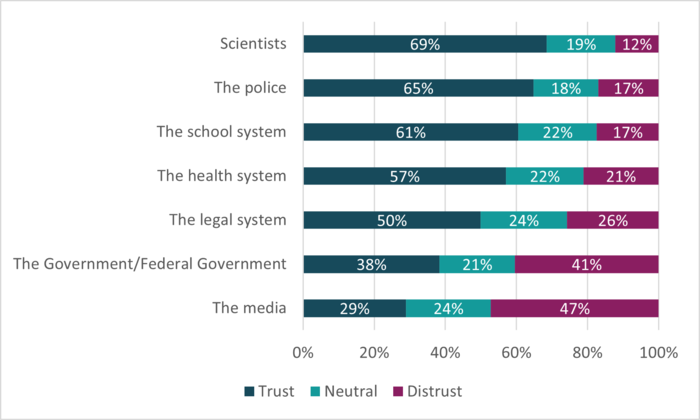
Horizontal bar chart showing levels of trust, neutrality and distrust in institutions. Scientists are the most trusted (69%), followed by police (65%) and the school system (61%). Trust is lowest for the media (29%) and the federal government (38%), which also have the highest levels of distrust.
Proportion of respondents who trust professions and institutions. Question: How much do you personally trust the following institutions or professions in Australia/New Zealand? (Seven-point scale from 1 = “Not at all” to 7 = “Completely”).

Trust in food system actors 

Farmers and producers were the most trusted group in the food system. They were trusted (scored above the midpoint) by 82.9% of respondents. The least trusted were food retailers, trusted by 57.8% of respondents. 
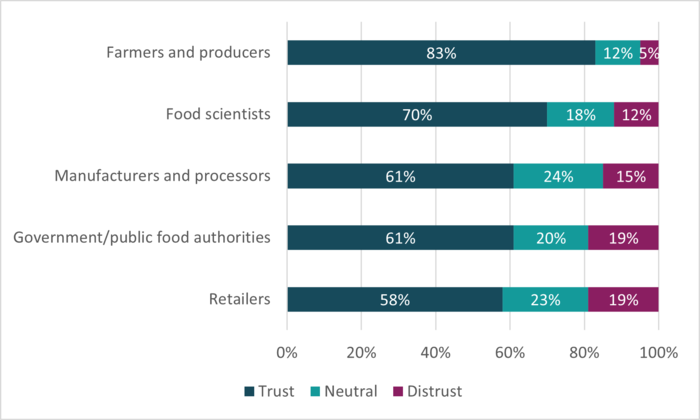
Horizontal bar chart showing levels of trust, neutrality and distrust in actors in the food system. Farmers and producers are the most trusted (83%), followed by food scientists (70%). Trust is lowest for retailers (58%), although distrust remains relatively low across all groups.
Proportion of respondents who trusted actors in the food system. Question: How much do you trust the following people or groups to do their part to ensure that all food (including drinks) sold in Australia/New Zealand shops and supermarkets is safe to eat? (Seven-point scale from 1 = “Not at all” to 7 = “Completely”).

Confidence in the safety of the food supply 

The majority of respondents in 2025 (70.3%) were confident (rating above the midpoint) that food sold in Australia and New Zealand is safe to eat, 16.3% were neutral and 13.4% were not confident. Level of confidence in food supply has remained steady since 2023. 
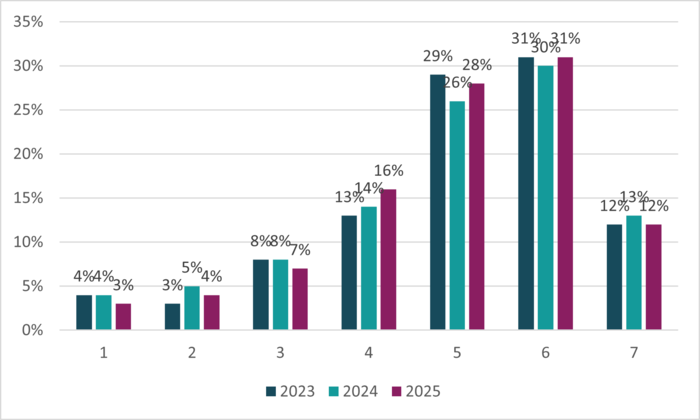
Bar chart comparing respondents’ confidence in the food supply (levels 1–7) across 2023, 2024 and 2025. Confidence peaks at level 6 (around 30–31%) and level 5 (26–29%) in all years, with very low proportions at levels 1 and 2 (3–5%).
Proportion of respondent’s level of confidence in the Australian/New Zealand food supply by year. Question: “How confident are you that all food (including drinks) sold in Australian/New Zealand shops and supermarkets is safe to eat.” Responses were on a seven-point scale, where 1 = “Not at all confident” and 7 = “Completely confident”.

Awareness and trust of FSANZ 

In 2025, 41.6% of respondents had never heard of FSANZ before, 28.4% had heard of FSANZ before but knew nothing about what it does, 26.4% knew at least a little about FSANZ and what it does, and 3.6% knew a lot about FSANZ and what it does. Awareness has remained the same since 2023.  

The majority of respondents who knew about FSANZ trusted FSANZ. Of the three trust items, the proportion who trusted FSANZ ranged from 77 – 79%.  
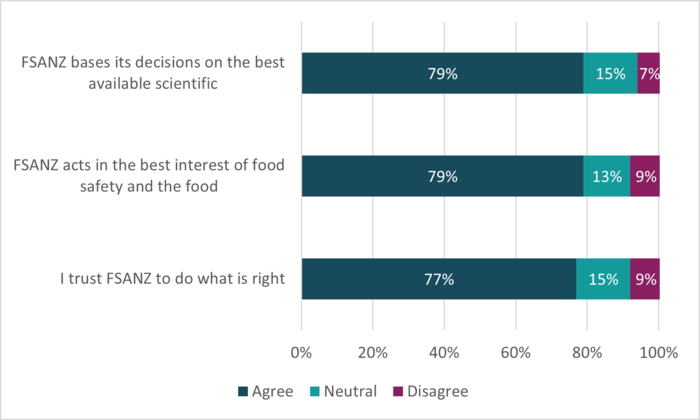
Stacked horizontal bar chart showing respondent trust in FSANZ in 2025. About 77–79% of respondents agree that FSANZ bases decisions on scientific evidence, acts in the best interest of food safety, and does what is right. Neutral responses account for around 13–15%, and disagreement is below 10% for all statements.
Proportion of respondents trust in FSANZ in 2025 (n = 670). Question: How much do you agree or disagree with the following statements? (In these statements, FSANZ means Food Standards Australia New Zealand) (1 = “Strongly disagree” and 7 = “Strongly agree”). Agree = score of 5, 6, 7 on the seven-point scale; Disagree = score of 1, 2, 3; Neutral = score of 4.

Health and dietary behaviours 

Dietary influences 

In 2025 80.0% of respondents had at least one dietary factor influencing their food choices. For all years (2023 to 2025), the most important factor influencing consumers’ food choices was cost of living pressures (selected by 57% in 2025). 
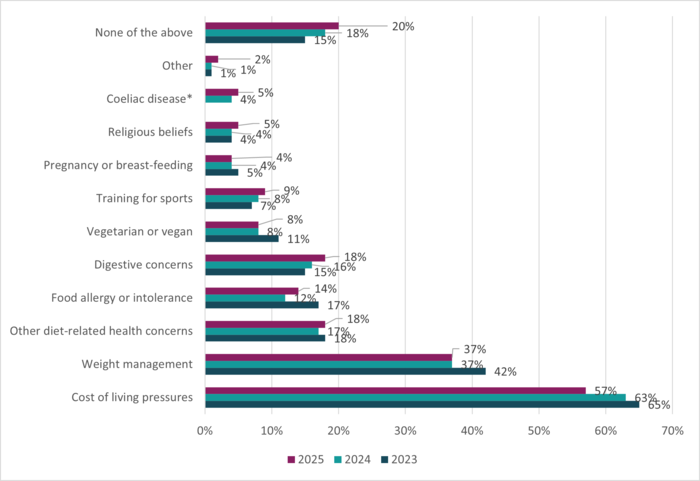
Horizontal bar chart showing the proportion of respondents selecting different factors influencing food choices in 2023, 2024 and 2025. Cost of living pressures are the most frequently reported factor, increasing from about 63% in 2023 to 65% in 2024, then decreasing slightly to 57% in 2025. Weight management is the next most common factor, reported by around 37–42% of respondents. Other commonly selected factors include diet‑related health concerns, food allergy or intolerance, and digestive concerns. Smal
Factors influencing food choices by year. Question: Do any of the following currently affect the food choices you make for you or your household? (Please select all that apply). *Coeliac disease was grouped with all digestive concerns in the 2023 survey but was a separate response option in the 2024 survey.

Food values 

Excluding taste and price, nutrition was the most frequently selected food value, with 75% of respondents selecting it in their top three. This is consistent with respondents top three food values of 2024 and 2023. 
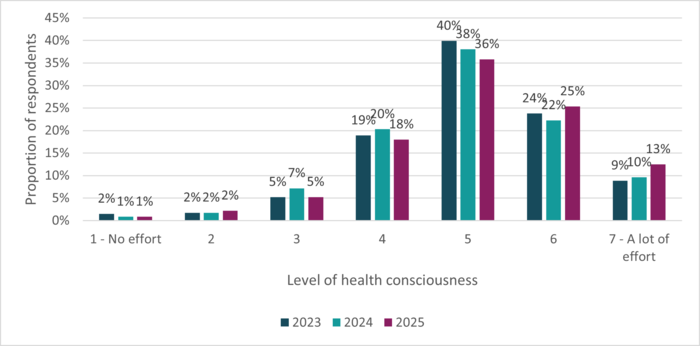
Grouped bar chart comparing respondents’ level of health consciousness from 1 to 7 across 2023, 2024 and 2025. The largest proportions are at levels 5 and 6 in all years, while very few respondents report the lowest levels.
Proportion of respondents of level of health consciousness by year. Question: How much effort do you generally put into maintaining a healthy diet for you and/or your household? 1 = “No effort”, 7 = “A lot of effort”.
Page last updated: 2 April 2026