FSANZ collects and reports annual, 5 and 10-year data on Australian food recalls. The data presents the reasons for food recalls and the types of foods recalled, as well as detailed analysis of causes (e.g. allergens and contaminants) and corrective actions taken by food businesses. Our statistics help identify trends and common issues in food recalls, supporting effective management to minimise the occurrence of future incidents.
Foods recalled annually represent a small proportion of total products available in the Australian food supply. Most recalls are undertaken as a precautionary measure by the food businesses to ensure potentially unsafe food is removed from distribution and sale. Only a small number of food recalls are linked to reported cases of illness or injury.
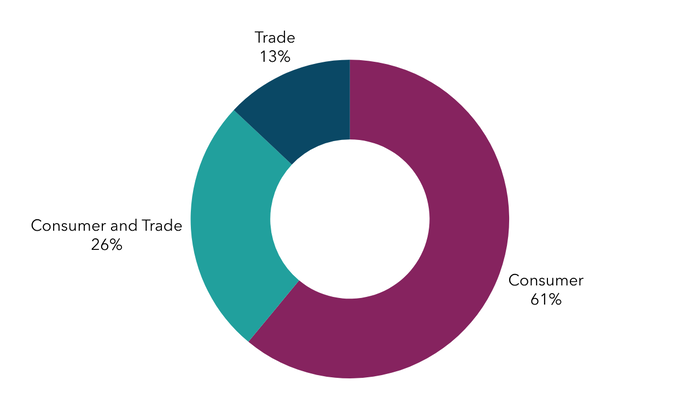
There are 2 types of food recalls - consumer and trade. A consumer recall occurs when the food has been available for retail sale. A trade recall is conducted when the food has not been available for direct purchase by the public (e.g. food sold to wholesalers and caterers). While food recalls generally can be categorised as consumer or trade, some recalled products may fall into both categories. Figure 1 shows that from 2021 to 2025, the majority of recalls coordinated by FSANZ were consumer recalls only (61%). Trade recalls and trade and consumer recalls accounted for 13% and 26% respectively.
Food recalls over the past 10 years
FSANZ has coordinated a total of 866 recalls from 1 January 2016 to 31 December 2025, including 92 recalls in 2025. While the number of recalls fluctuates year-on-year, the average annual number of recalls has shown an overall upward trend over the past decade (see Figure 2). The average number of recalls per year from 2016-2025 was 87.
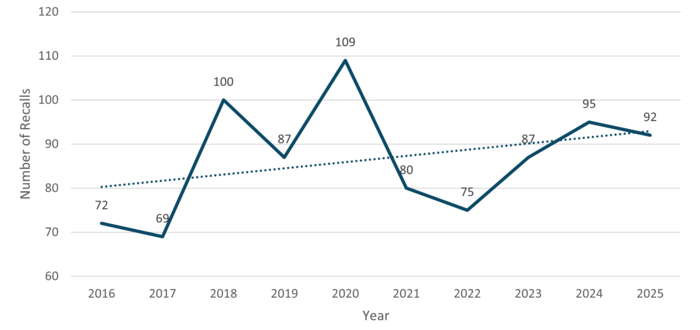
A year-on-year or average annual increase in the number of food recalls can point to particular issues in the food supply but also indicate system safeguards are working. The majority of recalls are precautionary and proactive, instigated by the food business in response to problems detected through mechanisms including internal monitoring and testing, or retailer and consumer reporting.
Understanding food recalls: a look at the past 5 years
Reasons for food recalls
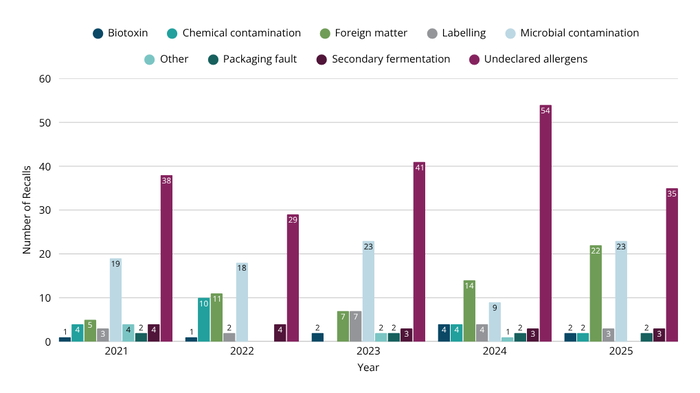
Food recalls occur for a variety of reasons. As shown in Figure 3, the most common reasons for recalls from 2021 to 2025 were Undeclared allergens and Microbial contamination. The Other category encompasses various recall reasons not already listed, such as products containing prohibited ingredients.
Types of food recalled
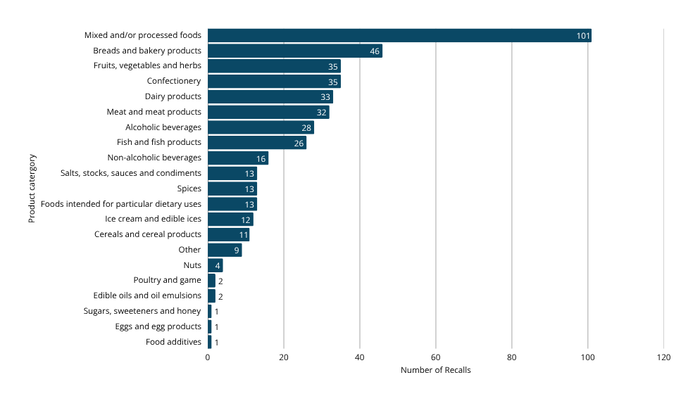
A wide variety of food products are recalled every year. From 2021 to 2025, the most commonly recalled food type was Mixed and/or processed foods. Breads and bakery products, Fruit, vegetables and herbs and Confectionery were also amongst the most commonly recalled food products (see Figure 4).
Corrective actions
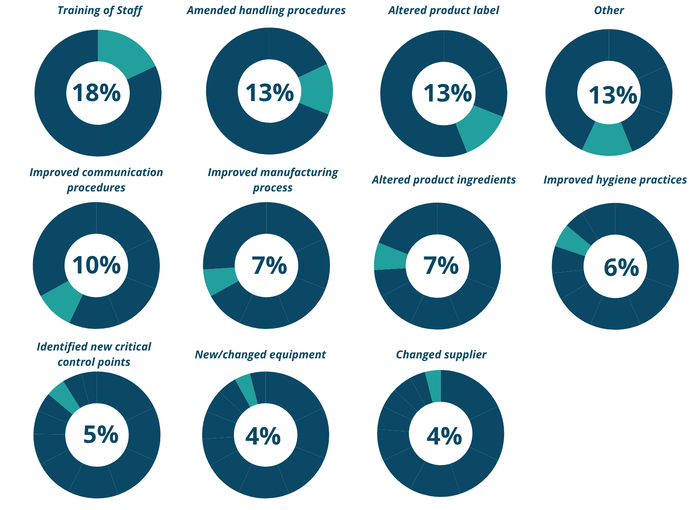
Food businesses who have undertaken a recall are required to report the corrective actions they have taken to address identified issues. From 2021 to 2025, the most commonly reported corrective actions were Staff training (18%), Amended handling procedures (13%) and Altering product labels (13%) (see Figure 5). The Other category included corrective actions such as increased testing and ceasing production or supply. It is worth noting that 78% of food businesses reported undertaking more than one corrective action. In Figure 5, every corrective action reported has been accounted for separately.
Undeclared allergen food recalls
Food products not compliant with the allergen labelling requirements set out in the Australia New Zealand Food Standards Code can pose a serious risk to people with allergies. Food products are often recalled due to the presence or the potential presence of undeclared allergens.
Undeclared allergens continue to be the primary reason for food recalls in Australia. From 2021 to 2025, there were 197 food recalls due to undeclared allergens. Table 1 shows the number and percentage of total recalls due to undeclared allergens over the past 5 years.
| Year | Number of recalls due to undeclared allergen(s) | % of total recalls for that year |
|---|---|---|
| 2021 | 38 | 48% |
| 2022 | 29 | 39% |
| 2023 | 41 | 47% |
| 2024 | 54 | 57% |
| 2025 | 35 | 38% |
| Total (2021–2025) | 197 |
Allergen types
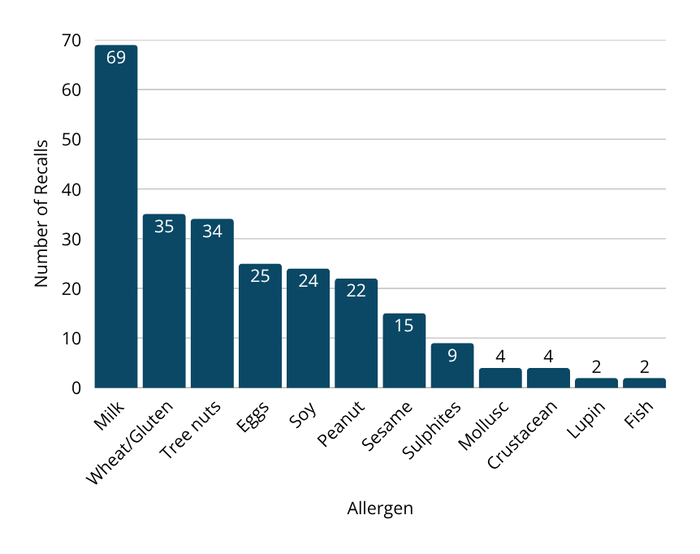
Most undeclared allergen recalls were due to the presence of a single undeclared allergen. However, 16% of undeclared allergens recalls were due to the presence of multiple undeclared allergens. Figure 6 illustrates the allergen types associated with recalls over the past 5 years. The most common undeclared allergen types were Milk, Wheat/Gluten and Tree nuts. Please note that when multiple allergens were associated with a single recall, each allergen has been listed as a separate entry on the graph.
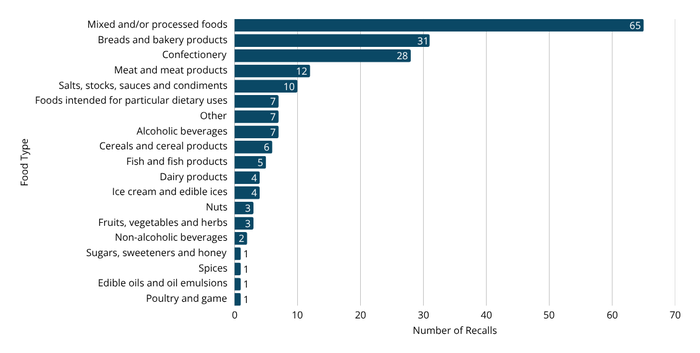
From 2021 to 2025, the most common food type associated with undeclared allergen recalls was Mixed and/or processed foods (65 recalls; 33%), followed by Breads and bakery products (31 recalls; 16%) and Confectionery (28 recalls; 14%) (see Figure 7).
Undeclared allergens - problem detection
FSANZ collects data on the method of detection to pinpoint how food products containing undeclared allergens are identified. Table 2 illustrates the 5 detection categories, with Customer complaints being the most common method. Other includes methods not captured by other categories or where this information was not reported.
| Year | Customer complaint | Distributor or retailer complaint | Routine government testing | Routine testing by the company | Other |
|---|---|---|---|---|---|
| 2021 | 20 | 0 | 8 | 0 | 10 |
| 2022 | 11 | 1 | 3 | 9 | 5 |
| 2023 | 19 | 1 | 8 | 6 | 7 |
| 2024 | 20 | 5 | 4 | 10 | 15 |
| 2025 | 21 | 3 | 2 | 3 | 6 |
| Total (2021–2025) | 91 | 10 | 25 | 28 | 43 |
Undeclared allergens - root cause
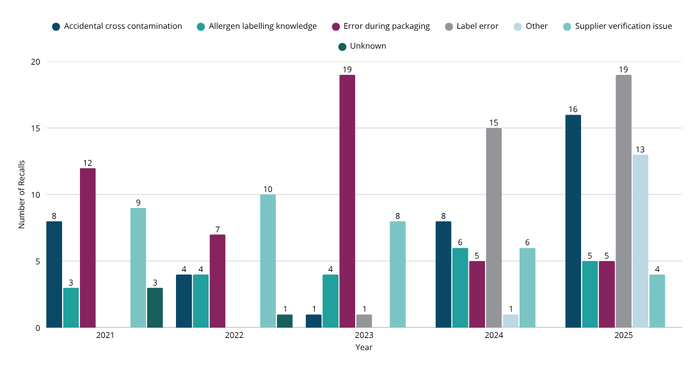
FSANZ uses information provided at the time of recall and in post recall reporting to determine the root cause of undeclared allergen recalls. FSANZ has reviewed allergen-related recalls and categorised these into the following 6 root causes:
- Accidental cross contamination - contamination of raw ingredients or during the production process.
- Allergen labelling knowledge - a lack of allergen labelling awareness or the misinterpretation of labelling requirements by a food business.
- Error during packaging – for example, a product being packed into the wrong packaging.
- Label error - examples include incorrect translation or reformulation of ingredients.
- Supplier verification issues - ingredient changes by a supplier not being communicated.
- Unknown - unable to determine what caused the issue at the time of recall.
Between 2021-2025, the most common cause of undeclared allergens recalls was Errors during packaging. Further to this, Accidental cross contamination and Supplier verification issue were significant root causes identified (see Figure 8).
Microbial contamination food recalls
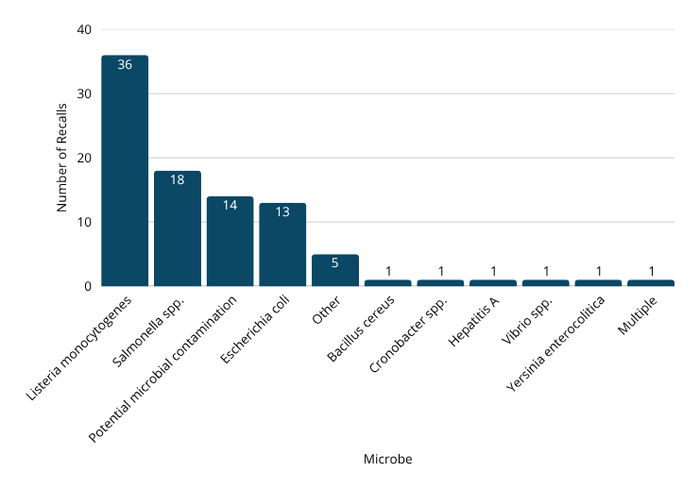
Microbial contamination refers to the presence of harmful bacteria, virus, fungi or parasites in food that can cause illness. From 2021 to 2025 there were 91 food recalls due to microbial contamination, one of which was attributed to multiple microbe types. As shown in Figure 9, the most common microbes were Listeria monocytogenes (36 recalls; 40%), Salmonella spp. (18 recalls; 20%) and Escherichia coli (13 recalls; 14%). There were also 14 recalls due to Potential microbial contamination.
Foreign matter food recalls
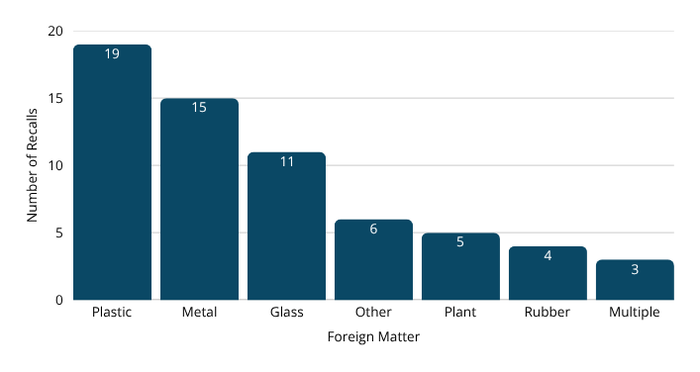
The presence of foreign matter (e.g. glass, metal or plastic) in food can cause injuries. From 2021 to 2025 there were 60 recalls due to foreign matter, 3 of which were attributed to multiple types of foreign matter. The most common types of foreign matter were plastic (19 recalls; 32%), metal (15 recalls; 25%) and glass (11 recalls; 18%) (see Figure 10). The Other category includes foreign matter such as biological matter and intrinsic objects (e.g. bone).
Biotoxin food recalls
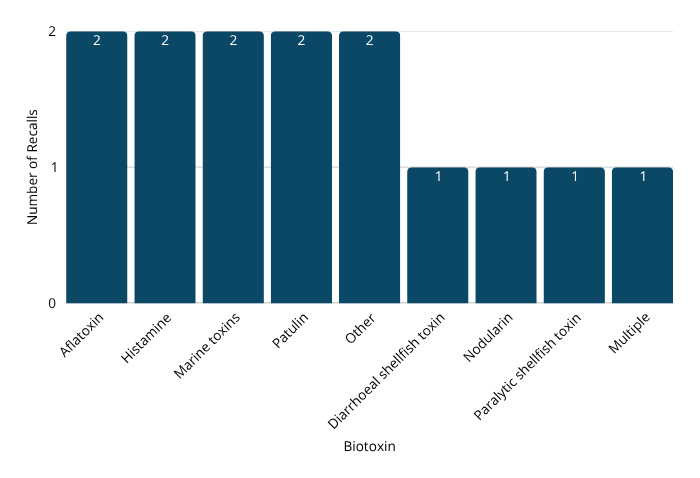
Biotoxins are toxic substances produced by a range of living organisms including bacteria, fungi, animals and plants. Food products contaminated with biotoxins pose a health risk and may cause illness or injury if consumed. From 2021 to 2025 there were 14 recalls due to biotoxins. As shown in Figure 11, the most common biotoxins were Patulin (2 recalls; 14%), Histamine (2 recalls; 14%), Marine toxins (2 recalls; 14%) and Aflatoxins (2 recalls; 14%). Other includes biotoxins not captured by other categories.
Chemical contamination food recalls
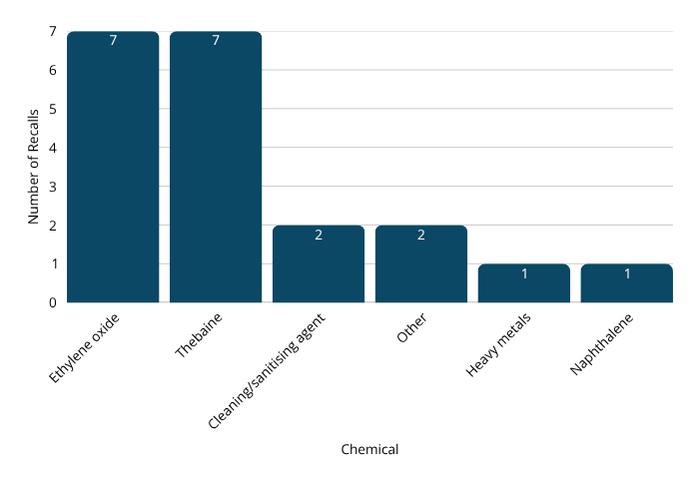
Contamination with chemicals like cleaning products and pesticides or high levels of additives can make food unsafe for consumption. From 2021 to 2025 there were 20 food recalls due to chemical and other contaminants. The most common contaminants were Ethylene oxide (7 recalls; 35%) and Thebaine (7 recalls; 35%) (see Figure 12 below).